All Categories
Featured
Amsterdam Dating Coaches Against 50,000 USD Matchmaking P...
Typical Mistakes When Choosing An Amsterdam Relationship ...
Improve Your Connections By Hiring An Amsterdam Dating Coach

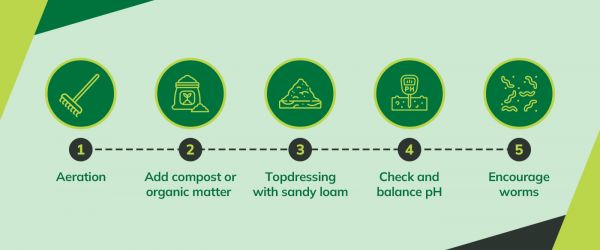
Key Tips for Improving Lawn Soil Health
Once cooled, it can simply be utilized to water the plants. This service is rich in vitamins and minerals, reinforcing the soil instantly.
Fruit and Vegetable Scraps Scraps like apple peels, lettuce leaves, and carrot tops can be become fertilizer through home composting. This procedure leads to an abundant and balanced product that can be included into the soil. Nourishing the plants, composting considerably minimizes the amount of household organic waste, promoting a more sustainable routine.
Wood Ash Unprocessed wood ashes are abundant in potassium and calcium, perfect for reducing the effects of extremely acidic soils. They need to be applied in little amounts, combined with the soil, preventing excessive amounts that might compromise nutrition balance! This kind of fertilizer is especially suggested for gardens and veggie patches, promoting efficiency and the durability of types.
Key Advantages of Organic Turf Maintenance Practices
Compost Tea Prepared from the fermentation of natural scraps, compost tea is a highly healthy liquid fertilizer. It can be sprayed on leaves or applied directly to the soil, functioning as a quick boost for weakened plants. It is a service that combines the richness of composting with the practicality of liquid application, offering visible results in a brief time.
All, even the richest soils can degrade with intensive usage, such as growing and gathering vegetables, fruit and flowers. The health of the soil can be supported through the usage of organic plant-based fertilizers and appropriate growing method.
Ways to Renovate Lawn Health Manually
If we follow natural laws of cyclicity, reuse and avoidance of waste, we can support the vigor of the soil and get the harvests we want. Plants themselves, including what we class as weeds, can be outstanding fertilizers. Such fertilizers are safe, organic, vegan and often cost much less than other choices, or absolutely nothing at all.
Making plants the source of fertility, instead of deficiency, tends to be a labour-, time- and money-saving method. Making use of plants as fertilizers also helps to develop self-sufficiency and deal with crucial ethical concerns associated with farming and gardening. This was pointed out by Iain Tolhurst, a business small-scale vegetable grower from South Oxfordshire, UK.
No-stock methods farming or gardening where no items of animal origin are used. Minimizing the usage of animal items is crucial not only since of the problems of cruelty and exploitation of animals that plague contemporary commercial farming. Animal farming is likewise incredibly resource extensive. Researchers argue that to avoid logging, damage of environments and the loss of biodiversity, it needs to be drastically lowered.
Expert Turf Practices for Thicker Grass
Preferably a farm or a garden need to be self-dependent, look after their own fertility and not count on inputs from outdoors. Tolhurst runs his farm using only plant-based fertilizers produced on his own land. The most essential of these is green manures. They help to ensure that the land is never bare and for that reason there is no loss of fertility as a result of erosion or rinsing of nutrients due to rain and snow.
He likewise uses a seven-year rotation on his fields, where green manures occupy 2 whole years of rotation. Tolhurst started farming over thirty years earlier on land that was so bad and stony that it was considered inappropriate for agricultural use. With his approach, remarkably, he has actually had the ability to run a successful business farm.
This contrasts with commercial farming where the deficiency of land is a significant seasonal issue. Plants can be used in 4 ways to keep the fertility of the soil, to improve its structure, to cleanse it and to reduce the threat of disease and erosion: As green manure when plants are grown and after that integrated into the soil.
As a liquid fertilizer when plants are fermented to release nutrients and utilized to water crops. Field planted with green manure phacelia (purple). They are incorporated into the soil before a brand-new crop is planted.

Latest Posts

Amsterdam Dating Coaches Against 50,000 USD Matchmaking Packages
Typical Mistakes When Choosing An Amsterdam Relationship Guru
Improve Your Connections By Hiring An Amsterdam Dating Coach